Showing posts with label Barack Obama. Show all posts

Friday, April 28, 2017

It's Not About The Money-It's About The Injustice

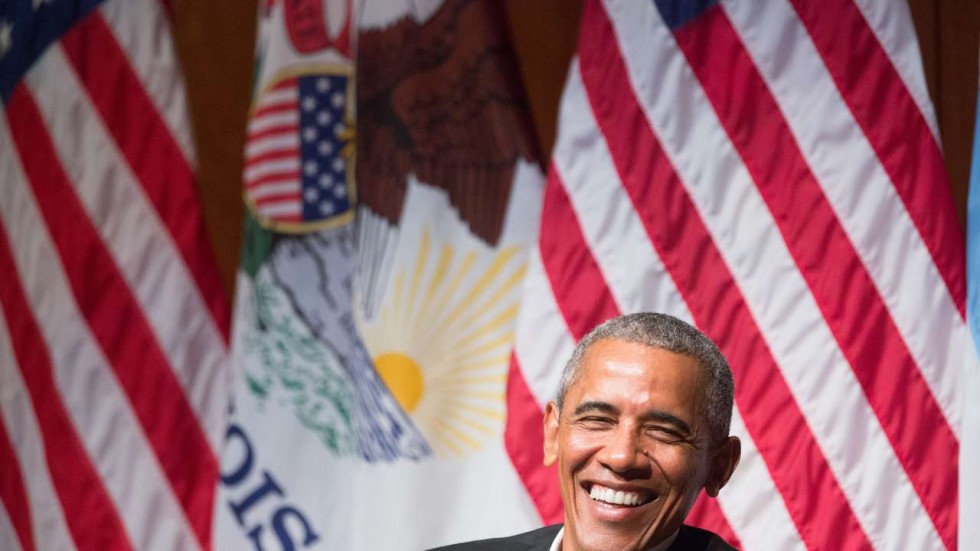
http://cdn3.i-scmp.com/sites/default/files/styles/980x551/public/images/methode/2017/04/26/f6eecae4-2a6b-11e7-acff-d77f13c4971d_1280x720_185641.jpg?itok=TZuSosEN

In response to the widespread indignance over Barack Obama's having taken $400,000 from the Wall Street firm he'll soon give a speech to, Trevor Noah made a very good point in Obama's defense: "So the first black president must also be the first one to not take money afterwards?"

Noah then made an even more keen observation: "Instead of focusing on how Obama can make so much money from Wall Street for a speech, maybe we should be asking why Wall Street has so much money to give people for a speech: the loose regulations, the intensive lobbying and favorable — you know, the truth is, we can't get into all of this, there's too much, there's too much else that's going on that we have to talk about today." I'd like to get into it a lot more, actually, because there's a lot more to it than what Noah and the other liberals we see coming to Obama's aid on this Wall Street speech issue are saying.

The main defense they like to use seems to be that Obama has a right to take speaking fees, Wall Street firm or no Wall Street firm-sure, $400,000 is a lot for one speech, but why not let him make some money? This argument, similar to the one they like to use whenever a Democratic candidate takes corporate donations of "money makes the world go round," misses the entire reason so many aren't pleased with the situation.

Personally, my attitude wouldn't be any different if Obama's speech had paid a dollar, or if he somehow didn't have a legal right to make money in this way. Because as long as he's being rewarded by Wall Street, there is something deeply unjust about the whole thing.

I'm talking about the fact that, in accordance with Noah's righteous calls for focusing on the deeper problem of Wall Street greed, the resentment from progressives and others about Obama's compensation from the banks has everything to do with said greed. Obama and his party, whose financial relations with the major banking firms go a long way back, can be held responsible for virtually all the excessive power Wall Street currently holds. Obama, along with a crucial amount of other Democratic senators, voted to pass Bush's unnecessary and financial control-consolidating Wall Street bailouts in 2008.

Then, no doubt partly at the behest of the Wall Street insiders within the Obama administration, they took basically no action aside from Dodd Frank. They didn't prosecute the bank executives responsible for the crash, and most importantly they didn't undo the Clinton Wall Street deregulations, which are largely behind the crash in the first place. The results of this were disastrous.

Despite Democrats' (not even accurately founded) back-patting about the unemployment rate having gone below 5% under Obama, the recovery has been what I like to describe as a tower made of toothpicks. The housing bubble has blown right back up, along with the massive overestimation of stock and bond prices. This, coupled with the unprecedented financialization of the economy amid Democrats' failure to break up the banks, along with the record federal debt amid Democrats' failure to sufficiently raise taxes on the wealthy, has created grounds for a new economic crisis. And a crisis that's not far off at all, judging from the bursts in parts of the housing bubble that have already begun to appear.

To be fair, this next crash will also largely involve a reckoning with various larger forms of accounting fraud that society is tied in with too deeply for Obama to have fixed, such our dependence on a petroleum economy. But the reality is that a repeat of 2007-2008 is coming right up, and had Obama and Friends enacted the necessary reforms this crash wouldn't be anywhere near as bad. We also wouldn't have had the resurgence of the GOP and the election of Donald Trump, thus making those reforms here to stay, but that's a different story. My point is that while Noah also protested in his Daily Show rant that change doesn't start with Obama, at a crucial point in history, it did. And the unwillingness of Obama and his party to act at that point has had consequences we'll soon see the full catastrophic scope of.

And now Obama is being paid by the same financial institution whose industry he partnered with for eight years to transfer money away from the lower classes, and which is about to evaporate the money of said classes before quite possibly making another profit through new Wall Street bailouts. You see now, Trevor, why some aren't applauding with your show's audience at that?

In regards to this, along with the countless other hypocrisies and injustices that the Democratic Party has been involved with since its leadership's neoliberal transformation around forty years ago, I doubt the producers of the Daily Show or many other pro-establishment liberals will acknowledge there's a problem. Whatever Noah's personal views on Obama's legacy and the Democratic establishment, he and the rest of the beloved late night liberal comedy crew serve major media institutions that are more than fine with seeing these problems ignored or, better yet, re-framed in a positive light. Thus, it's no wonder Noah was allowed to briefly advocate for standing up to the rigged banking system in the quoted segment-as long as he deflects attention from the root causes of said system, him criticizing Wall Street itself is evidently nonthreatening to the oligarchy.

The good news is that as of the last couple years, every time one of the Democratic establishment's spokespersons has made power-serving statements like the ones mentioned, a consequential facet of the population has reacted by doing something to enact change. And 2016 Democratic primary election theft or not, their efforts are working quite impressively. After a month and a half of Medicare for all supporters leaderlessly pressuring House Democrats to support the H.R. 676 single payer bill, 98 out of the 193 said Democrats are now co-sponsoring it; according to the research of one Warren Lynch, Berniecrats have mostly taken over thirteen state Democratic parties; and as membership in the Democratic Socialists of America has grown rapidly in recent months, so has the electoral success of candidates who share its agenda.

So the types of progressives who aren't cheering on this objectively unfair spectacle of an ex-Wall Street president taking Wall Street money appreciate the concern of the Daily Show's corporate string-pullers, but we're not adopting their cheery attitude about it, not to mention about the monumental flaws in our economic and political systems that it represents. And when extreme financial concentration soon results once again in economic disaster, we expect many of the remaining loyal Democrats, who will suddenly find themselves scarcely able to pay for basic needs let alone cable to watch The Daily Show shortly after Obama left office, to join us in working towards the creation of a society that works for all of us.

But hey, Obama has a right to make money.

Tuesday, January 10, 2017

How Obama And The Democratic Party Saved The Country


As Barack Obama signs off with his farewell address ten days before he leaves office, he and his party leave behind a legacy which will be appreciated for generations. What follows is a look back on it.

One of his administration's first and most important accomplishments was bringing sufficient reform to the nation's banking system. After voting against and outspokenly opposing the Bush administration's Wall Street bailout as a Senator in 2008, Obama took immediate action upon entering office to call it off and rein in the financial sector. By the end of 2009, Obama and the similarly anti-corporatist Democrats in the House and the Senate had prosecuted all the banking executives who were responsible for the 2008 financial crisis, repealed Bill Clinton's disastrous Wall Street deregulations, and broken up the too-big-to-fail banks which once threatened our economy.

Had they not done this, a new and even bigger financial crash would likely be looming by now.

Other major ways Obama and the Democrats ended the control which corporations and the super rich held over our society at the time included de-consolidating the major media companies, reforming campaign finance so that corporate cash no longer had any say in the actions of politicians, drawing out of and avoiding "free trade" agreements, repealing the tax cuts of George W. Bush and other past presidents to make way for a tax system similar to that of the FDR era, granting the homeowners hurt by the 2008 crash a sufficient bailout, and raising the federally mandated minimum wage to $15 an hour.

Had they not done these things, economic inequality in America, now at its lowest in decades, would no doubt be higher than ever.

On foreign policy, Obama thankfully governed in antithesis to his predecessor. From the start, he and his similarly anti-war cabinet made every effort to get the U.S. out of the War in Afghanistan and then the War in Iraq after Bush's 2008 extension bill of it expired in 2011; they wisely abandoned the U.S. military's drone program; they greatly reduced America's at the time massively bloated military budget; they avoided U.S. involvement in the 2011 "humanitarian intervention" in Libya; they maintained good relations with Russia; they were careful to avoid escalating the conflict in Syria; and they avoiding what would have essentially been a repeat of the Invasion of Iraq by declining to go to war with ISIS in 2014.

Had they not done these things, George W. Bush's foreign policy model would have more or less continued for eight more years, dealing thankfully untold damage to global stability.

Thanks to all this, along with the passage of universal health care in 2010 and the dismantling of Bush's surveillance state in 2009, Obama and the Democratic Party retained their initial popularity throughout the next eight years. Democrats were able to beat back the right-wing populist movement that appeared in 2009 and 2010 by sweeping the latter year's midterm elections. Obama won re-election in a landslide in 2012 as Senate and House Democrats were able to largely do the same as well. And while Republicans made some gains in 2014, the Democrats were once again able to hold onto the majority in the Senate and the House.

Had they not been able to keep the Republicans at bay, America's enormous gains these past eight years in the effort to combat climate change would likely not have been made.

And perhaps most fortunately of all, Obama was able to ensure a reliable protector of his legacy succeeded him. Had Obama not worked to change the Democrats into a party of the people, the Democratic National Committee and many Democratic primary election officials would likely have tried to sabotage the campaign of Bernie Sanders. But Obama's would-be secretary of state Hillary Clinton was of course again defeated, allowing Sanders to become president-elect in 2016.

Had Obama and his party not done any of this, faith in the Democratic Party and other established institutions would likely have deteriorated by now, allowing for some sort of right-wing demagogue to fill the political vacuum.

But fortunately, they took a far wiser path. Thank you, Obama and your party, for everything you've done.

Wednesday, December 7, 2016

The New Backlash

In my previous article, I argued that the differences between the two main factions of the political left are too dramatic for them to fully reconcile any time soon. However, to follow up with something encouraging after publishing that somewhat negative piece, I'll now make the case for something else that I believe will happen  throughout the next few years: the emergence of a left-wing backlash during Trump's term which will be more powerful than the right-wing backlash that occurred during Obama's term.

The latter movement, as we know, has made a serious impact on American political history. After the Democratic sweeps in 2006 and 2008, grassroots conservative activists-mainly the ones on the far right-wasted no time trying to regain their dominance over politics. In the months after Obama's inauguration, the political vacuum of right-wing populist anger that had appeared was filled by the Tea Party, Fox News demagogues like Glenn Beck, and far-right groups like the Oath Keepers.

And while the Tea Party peaked early in Obama's presidency, the former followers of it and lesser right-wing populist movements that appeared around that time have since enormously influenced government. Tea Partiers managed to get a considerable amount of their representatives elected in 2010, and later elected their ideological heir Donald Trump to the presidency. They've also turned the tables on the Democrats, with the Democratic Party now being in worse shape electorally than Republicans were in 2008.

This all would seem to vindicate the post-election celebrations of Trump supporters. But the hidden weakness in the political structure that the far right has built in the last eight years is that not that much of the electorate helped build it. Specifically, around 26% of Americans were involved in the construction.

"The full backlash wasn't really 47 percent," wrote Will Bunch in his 2010 book The Backlash: Right-Wing Radicals, High-Def Hucksters, And Paranoid Politics In The Age Of Obama, referring to the percentage of the vote that John McCain received in 2008. "As the first weeks of the Obama administration dragged into months, the parameters of the hard-core resistance emerged, with a figure that was attached to 26 percent, maybe less. These were the 26 percent of Americans, according to Newsweek, who still approved of George W. Bush in the waning days of his presidency; the 26 percent who in 2009 said they'd like to see Sarah Palin as Obama's successor in 2012, according to CBS; the 26 percent who reported to Fox News they were outraged when President Obama bowed to the Japanese emperor; the 26 percent who believed Obama's 2008 election was not legitimate, that the much ballyhooed antipoverty group ACORN had somehow swooped down and 'stolen' the contest by recruiting new voters in the heavily black and Latino communities."

And when you look for the polls that show how big the similarly radical left is, the figure is more than two times bigger than 26 percent. It's 52 percent of Americans who believe in high taxes on the rich to redistribute the wealth; it's 59 percent of Americans who supported Occupy Wall Street; it's 56 percent of Americans who have consistently believed throughout the last 30 years that the wealth should be more equally distributed; and it was 53 percent of Americans who would have voted for Bernie Sanders in the 2016 general election had he been the Democratic nominee. None of this is surprising, seeing as even more than 52 to 59 percent of Americans generally support the goals of Sanders and Occupy, if not Sanders and Occupy themselves.

In other words, left-wing populists outnumber right-wing populists by 2 to 1 at the least. And thus during the Trump era, I believe we are going to witness a backlash to the backlash which far surpasses the former one in its strength and impact.This belief of mine is supported by the fact that unlike was the case with the right-wing backlash just a month after Obama's 2008 election, the left-wing counterrevolution has already started.

Bernie Sanders has emerged in the weeks since the election as a dynamic figure in the effort to organize a progressive backlash, participating directly in the anti-oil pipeline protests in Standing Rock, North Dakota, calling for an overhaul of the Democratic Party's corporatist leadership, and holding public events that resemble his campaign rallies. He's just one of the many progressive leaders who have been working towards such a movement in the past month, among them Michael Moore, who's advocated for an anti-Trump resistance "that will dwarf Occupy Wall Street."

And if public opinion polls and the behavior of Americans so far after the election are any indication, he'll get one. In addition to all of this, donations to organizations that oppose Trump's agenda have surged, with the fundraising of the ACLU, for just one example, having gone up by 7000 percent within the first 24 hours after the election.

Even Trump's supporters have admitted that his presidency will provoke massive resistance, such as when Rush Limbaugh said in July regarding the political dynamics that would be put into motion in the event of a Trump victory on a Election Day, "I want you to think: What’s going to happen that night? What’s going to happen the next day? What’s going to happen every day there after? What’s going to happen the day Trump gets inaugurated? What is the left going to do? They’re not going to just sit idly by and accept this."

No, we are not. Throughout Trump's presidency, it's reasonable to assume that there will be a constant series of protests, victories in electoral politics, and pressure put upon political leaders on the part of the left. And as progressives build this new political structure, the quarter or so of the population that built the old one will not only be rendered largely apathetic due to Trump's reassuring presence, but will be shrinking due to an increase in millennial and nonwhite voters.

In short, whereas Donald Trump and the Tea Party took control of the American political steering wheel in the age of Obama, Bernie Sanders and whatever Occupy-esque movement that emerges during the coming years will do the same in the age of Trump. And in this case, I suspect, the new driver will retain their role as the defining force in politics for quite some time.

But this movement will not just be in opposition to the new president. It will be going up against every leader and institution which defends the current economic paradigm of predatory capitalism, the Democratic Party being no exception. Unless Democrats soon start genuinely representing their base, the New Backlash will most likely become centered around an alternative political organization that's capable of addressing their needs, be it the Green Party or something else.

Whichever party or individual becomes the leader of this movement, though, every factor points to its success. And by the time it's likely gained control of the government four years from now, those on the left will be the ones saying that they've taken their country back.

Progressives will have some big opportunities throughout the next four years. Let's get to work on taking full advantage of them.

Wednesday, October 5, 2016

The Democratic Party's Demise Began Long Before Obama

This year will be the last wherein Shaun King plans to remain a registered Democrat. He announced his decision to abandon ship this May, when it was becoming apparent that the Democratic primaries had been stacked against Bernie Sanders too much for him to go into the convention with the majority of delegates. The reasons he gave for doing so, though, were bigger than him simply being disappointed with the results of an election; "Right now, the Democratic Party, which I have called home my entire life," King wrote, "is deeply in love with money. Consequently, its leaders have supported and advanced all kinds of evil, big and small, in devotion to this love affair."

I'm not the only one who agrees with him. Prior to this year's movement among many other Sanders supporters to leave the party after what its leaders in both the top and the lower levels did to undermine democracy, Democratic membership has been in free fall since 2009, with their numbers having dropped by 6% since then and independent identification having soared. This is no doubt the consequence of the fact that, despite the overwhelming public opposition towards corporate power in the midst of record income inequality, Obama and the rest of the Democratic elite have very much failed the poor by passing Wall Street bailouts, anti-worker "free trade" deals, a profit-based health care plan, and even cuts to the social welfare system. King and the millions of others who have left the party in recent years are right to think that the Democrats do not represent the interests of the people.

But the Democratic Party's abandonment of its base, and its base's abandoning of it, has been going on for a lot longer than seven years.

Though Democratic membership dropped and rose many times prior to 2009, there's another, perhaps even more important, way of determining a party's success: how many state legislatures its members hold. And according to this Washington Post chart from last year, when examining the recent history of that factor, a striking decline for the Democrats is noticeable.
This decline can partly be attributed to the rightward shift that occurred in American politics and culture during the 1980's, but a factor that can't be ignored is how this was when Democrats began to shift to the right themselves.

As I talked about in my last article, after Carter lost, Democrats began to shift their economic agenda towards something more elitist, letting Reagan pass his upper-class tax cuts and business deregulations despite holding the majority in Congress throughout his entire presidency. And though these things evidently drove away parts of their leftist base, causing them to lose some of their former hold on the majority in state legislatures, this was only the beginning of their fall.

As you can see, Democrats saw a drop during the mid 90's that ended their half-century period of electoral dominance. After the party's drastic pivot to the right in the 1992 election, they lost the Senate and the House in 1994. Again, while that wasn't the only factor that caused the Democrats to lose, it very much played a role.

And then came the 2000 election, wherein Ralph Nader revealed to many the hypocrisy and corruption of the Democratic Party as it had come to be. This contributed to their loss of the House that year, and their loss of both the House and the Senate in 2004. While the public's overwhelming disgust with the Bush Administration during the end of his term bought Democrats four brief years of hope with their taking back the legislative majority in 2006 and 2008, their refusal to move away from the right as their base was moving increasingly to the left has since caused that trend to be reversed.

While the dirty tactics that Republicans have employed in recent years such as voter suppression and gerrymandering have played a large part in the Democrats' decline since 2008, the evidence is undeniable: Democrats have been sowing their own gradual doom for the past thirty-five years or so by shifting to the right and creating voter apathy among their base.

And as this phenomenon is expected to continue in this and future elections, which will make America more vulnerable to being taken over by the dark, neo-fascist brand of populism that the Republican Party is becoming a vessel for, the solution is clear: scrap the unreformable Democratic Party and work towards the rise of a third party for the left. The Democratic ship has been sinking for decades, and when it finally goes under in the next few years, we'll need to find another one, or drown.

Thursday, September 1, 2016

Don't Bern Out

The movement that this site is based upon, despite of course being open to individuals of all political leanings, is largely being built (and was made possible) by former Bernie Sanders supporters. And as someone who is part of that group, I feel the need to give my fellow founders of the political revolution some advice.

Mainly, this message is directed towards a certain type of former Sanders supporter: the one who has, in essence, stopped supporting him.

All throughout the campaign, Sanders told us that change always takes place from the bottom up, that no president can ever achieve what the people can achieve when they recognize their own power. He even promoted a campaign slogan that reminded us of that fact-"not me, us."

But after the media, the DNC, and even the FBI worked to sabotage Sanders's chances of becoming the nominee, which gave him little choice but to give in, how his followers reacted would be the test of their character. If they accepted his decision despite not agreeing with it and moved on to continue his movement, they would pass.

And I fear that for the most part, they're failing that test. Far too much, I see Sanders supporters on social media expressing not just disappointment but bitterness for what happened, saying that their former leader "sold us out" and blaming him for supporting Hillary Clinton. I disagree as well with his choice to do so, and I'm also somewhat disappointed with how he largely did not address the election fraud that occurred, but I have enormous respect and gratitude for him nonetheless.

But the trait I witness in these types that I find the most disturbing is how now that many of them have moved on to the Green Party's Jill Stein, they're behaving exactly like they did during the primaries. They act as if she's the answer to every problem, and some of them believe that to such an extent that they've convinced themselves she has a serious chance to win.

I support Stein as well, but I have the realism to know that in the end, the votes she wins will help the Greens become successful in future elections, not somehow propel her to the presidency in this one. But the former Sanders supporters whose mindsets I'm respectfully calling into question just don't want to hear that. As one of my wiser colleagues Michael Sparks put what I'm talking about:
Today I'm seeing a lot of people in my feed saying that they are giving up on politics.
This is my greatest fear.
This is exactly what the establishment wants.
Bernie Sanders laid out an exact plan for us to win and spoke it to stadiums and backyards for 14 months.
Everyone screamed and went crazy, but I don't think very many were actually listening.
I think they heard...
"When I become President everything will be amazing!!"
When what he really said was...
"Not me, US!!"
"When millions of people stand together..."
and
"Change has always happened from the bottom up."
Bernie hasn't changed.
You have.
You were a poser revolutionary and now you expose yourself daily with your
"Bernie betrayed us" lies.
I can tell you were the ones who weren't listening.
They are now the ones who think that Jill Stein is going to be President and "everything will be amazing!!"
They are repeating the same pattern.
They aren't revolutionaries.
They are just looking for the next cult of personality.
They liked Bernie because he was a rock star and they like Jill for the same reasons.
When Bernie was cheated and told them that we could still win if we kept working, they turned on him and put Jill upon the same pedestal that they knocked Bernie off of.
On November 8, when Jill doesn't win a single state, these people will all cry about the rigged system and then quit politics with a bitter taste in their mouth.
They will be sitting on a bar stool twenty years from now complaining about how the whole world is a big setup.
They refuse to accept that change happens from the bottom up, because that is too much work.
These people aren't suited for the war of attrition that is politics.
Those of you who are intent on making actual change by overhauling your local government, I salute you.
You were the ones listening, in between the roars, in those crowded stadiums.
But soon, whether these people were listening or not, they'll no longer be able to afford to wallow in disappointment and refuse to be politically involved. Because for a while, they literally won't be able to afford many other luxuries.

Let's travel back to another moment when many were filled with the belief that one leader could fix everything: eight years ago. You remember that time, don't you? This amazing figure Barack Obama, who came into most of our lives only a year ago, had toppled the Clinton machine and was on his way to creating a new paradigm in human history. In his Democratic convention speech, his words felt like they spoke to us more than any others from a politician in recent memory: "America, we are better than these last eight years. We are a better country than this."

And Obama would soon have a very good opportunity to prove that he meant it. When much of America's banking system became undone in the month of September, President Bush, who's empty mind had been filled with banking industry propaganda during the past few months by his Secretary of the Treasury Henry Paulson, proposed a bailout for the Wall Street firms. The way the administration first introduced the bill to the senate made it clear that all later claims of a bailout being necessary to save the economy were false; on September 18, Paulson told members of congress that should they fail to meet the bankers' extravagant demands, the entire world economy would crash "within 24 hours."

The plan was so clearly unreasonable that 95 House Democrats shot it down. But when Paulson rewrote it to seem like something that was simply meant to help homeowners, and presented it in a less suspicious manner, the House and the Senate were on board. Or at least those of them who's political careers depended on donations from the same banks that wanted them to pass the measure. On October 1, when the Senate vote was being negotiated, Obama, who's campaign's second largest contributor was Goldman Sachs, made the best case he could for it, one that was mostly based on the claim that there would be an independent oversight committee to make sure that the banks would pay back the money to taxpayers.

But even after Senator Bernie Sanders (someone you may have heard of) made a solid case against it, informing his colleagues that the committee was not independent at all but handpicked to make it likely to let the banks off, nobody listened. The Senate approved the so-called Emergency Economic Stabilization Act, and after the House did the same two days later, Bush listened to what the grown-ups had told him and signed it into law.

But unlike the president, Obama was aware of what would come from his support of the bill. And we knew it; our anointed savior had quite literally sold us out, redistributing $700 billion of the taxes we payed to the nation's top bankers so that they could make the banking industry into an unregulatable monopoly that controlled far too much of the nation's wealth.

And yet, instead of switching to the Green Party, we continued to assume that change would simply happen on its own and kept Obama, and his party, afloat for the next eight years.

And the consequences of our mistakes are about to hit us. Hard.

Had a party that isn't corrupted by corporate interests been voted into prominence since 2008, the damage of the bailouts would be undone by now. The banks would have been broken up, their executives would have been forced to pay their fair share in taxes, and the money that they had stolen from the middle class in 2008-and for the past four decades-would have been returned to its rightful owners. But the opposite has happened; in spite of Obama's Dodd-Frank Act, the economy is now more financialized than ever, with the big banks sharing about a fourth of the country's corporate profits.

This is a disaster in the making. The 2008 crisis was so bad partly because the banks had become so powerful after the Clinton deregulations that when they went down, the effect on the overall market was far bigger than it had been in previous downturns. But now the economy is stuck in a dangerous cycle of accelerated peaks, which are always followed by a massive collapse.

And we've recently passed the latest peak.

Since late July, the stock market has been experiencing its least active period in twenty years. This is the most dramatic result of the many factors behind it; housing and stock prices have reached about the same level as they did in early 2007. And according to monetary historian Mike Maloney, this means that a possibly unprecedented event is fast approaching. "This is the peak," he said on August 29. "We have passed the peak of the bubble. It's now deflating. There is usually a little tiny roll over and then a huge crash. And the little tiny roll over is just starting right now. We are seeing it first in the top end (like luxury real estate), where the currency that was created by the central banks went to that 0.1% first. Within the next few years you are going to see probably the greatest crash in history. I have often said that the crisis of 2008 was just a speed bump on the way to the main event. We are in the process right now of seeing this unwind."

And that's not the only part of our economy that's being run unsustainably. As a result of the drop in fossil fuel prices that's occurred in the past few years as a consequence of increased alternative energy use, much of the fossil fuel industry is soon expected to go bankrupt. This alone, says Prestige Economics president Jason Schenker, could very well cause a recession sometime in the next few months that surpasses the magnitude of the one in 2008.

And here we are, on the brink of catastrophe, arguing about the a presidential candidate who left the race more than a month ago. I'm sorry I didn't come to you with a piece that offered nothing but encouragement and hope for the future, but the dark prophecy I just exposed you to is necessary to precede such material.

When this crash hits-which, I believe, will start sometime very soon indeed-it will serve as a wake up call for most Americans. All of a sudden, people will be directly faced with the fact that there is something deeply wrong with the system. What will they do then? Will the types of former Bernie people I mentioned stop feeling beaten down by the system and step up to change it for themselves? Will the Hillary people and the middle-class part of the Republican electorate stop pretending that the system works and join the Bernie people in revolt? Will the Trump people stop blaming their economic problems on scapegoats like foreigners and Muslims and turn against the class of Trump himself, who are the real culprits?

Some of them will. But in the short term, at least, I suspect that not even an economic collapse cannot jolt many of these Americans out of their stubborn preconceptions about how to approach their country's problems. That does not mean, however, that those of us who will be awake during those times should give up. Me, Bernie Sanders, and the rest of them will be the only ones fighting the all-important battle against the new Wall Street bailouts that Obama and friends will be pursuing, and the neoliberal order that's behind all of it.

So I ask of the Sanders supporters who abandoned Bernie's cause to stew in their unnecessary feelings of hopelessness: snap out of it. We need you. And if you do the work that will be necessary in the coming months and years, you'll be rewarded with something perhaps even greater than a President Sanders or Stein: change on all levels.

Sunday, August 14, 2016

Make No Mistake, The Democratic Party Is Dangerous


It was October 1, 2008, and the senate vote on whether banking oligarchs would be allowed to further dominate the economy  and eventually crash it again was being discussed. The problem was that the measure had the name "Emergency Economic Stabilization Act," which most in the House and the Senate were taking at face value. Among the supporters of the act were the majority of Democratic officials, including Barack Obama.

Obama made a seemingly solid case for the bailout when his time to speak came, explaining how he was satisfied with the terms that the administration had agreed to about making the banks pay back the appropriate amount of money to taxpayers. But as Senator Bernie Sanders sat behind him, he remained unmoved in his opposition to the measure, and he delivered an indisputable argument against the notion that it would help the interests of the people.

But most of the Democrats refused to listen, and two days later, the bailout was passed. As a result, the big financial institutions have become so large that they're no longer possible to sufficiently regulate, the five biggest banks control $15 trillion in assets according to the latest estimation (to put that in perspective, all of the wealth in the U.S. is $10.5 trillion), and the events that led up to the 2008 financial crisis have been repeated, this time with even worse consequences expected. And all because those Democrats in the House and the Senate gave in to the wishes of their donors in the banking industry.

In an infamous Democracy Now interview, Noam Chomsky once offered a scathing assessment of the Republican Party:
We should recognize—if we were honest, we would say something that sounds utterly shocking and no doubt will be taken out of context and lead to hysteria on the part of the usual suspects, but the fact of the matter is that today’s Republican Party qualify as candidates for the most dangerous organization in human history. Literally. Just take their position on the two major issues that face us: climate change, nuclear war. On climate change, it’s not even debatable. They’re saying, “Let’s race to the precipice. Let’s make sure that our grandchildren have the worst possible life.” On nuclear war, they’re calling for increased militarization. It’s already way too high, more than half the discretionary budget. “Let’s shoot it up.” They cut back other resources by cutting back taxes on the rich, so there’s nothing left. There’s been nothing this—literally, this dangerous, if you think about it, to the species, really, ever. We should face that.
And he's right. Though the mission of the Republican Party is to maximize the profits of banks and corporations, not intentionally exterminate an entire race as the Nazis wanted to do, because the logical extension of the Republicans' goal comes with ignoring the potential destruction of the planet, they are the group with the ability to do even more serious damage.

But as Chomsky would also agree, Democrats are not far behind. He said in another instance that
There used to be a quip that the United States was a one-party state with a business party that had two factions: the Democrats and Republicans—and that used to be pretty accurate, but it’s not anymore. The U.S. is still a two-party state, but there’s only one faction, and it’s not Democrats, it’s moderate Republicans. Today’s Democrats have shifted to the right.
As with the GOP, the threat that the modern Democratic Party's ideology poses is not that it explicitly promotes violence, human suffering, and environmental harm, but that it consists of a series of rationalizations which keep those enamored with it from recognizing that they're supporting these things.

When Democrats fail to pass universal health care despite being in control of the White House, the House, and the Senate, it isn't because they care more about the profits of insurance companies more than the lives of the uninsured, it's because they need to be realistic. When Democrats go along with Republicans'  disastrous idea to invade Iraq, it's not because they care more about the public opinion polls than the consequences of war, it's because they felt like the (easily disputable) evidence for WMDs at the time gave them no choice. When Democrats decide to stick to their story about the Wall Street bailouts helping ordinary Americans despite clear evidence to the contrary, it's not because they're beholden to their donors in the banking industry, it's because they need to compromise with the administration.

The list goes on and on. But what seems to occur in every one of the Democratic excuses for participating in a version of Republicanism is pragmatism. It isn't selling out when a Democratic politician accepts campaign contributions from the very same corporations and banks that Republicans do, refuses to stop a war, or pushes for a neoliberal trade deal; it's working within the system. "We all believe in economic opportunity for everybody," Delaware Democratic Governor Jack Merkel once said. "The difference between myself and senator Sanders and senator Warren is that they think that's not happening because the system is rigged, and I think it's not happening because the system is changing."

The problem with Merkel's Democratic worldview is that instead of recognizing the fundamental problems within our government and economy so that they can be addressed with the urgency and aggressiveness needed to solve them, it always encourages caution and negotiation as the best approaches. While such an incremental method is indeed necessary in some cases, to assume it's an inherently good governing approach is anything but rational.

Surrendering to the vastly powerful forces of neoliberalism whenever possible and then calling it incrementalism-which, overall, is a decent summary of what the Democrats have done-is, in a way, more dangerous than the open regressiveness of the Republicans. The only result of accepting this political philosophy, as we've seen this year, is that the Democratic Party becomes ever more militaristic, oriented towards the interests of big business, and even less progressive on social issues. And if this trend continues, the next step will be an official merging between the two parties on those crucial issues that Chomsky mentioned. They will both put the profits of fossil fuel companies above the stability of the climate. They will both be solely focused on redistributing wealth to the top. And they will both want to instigate and escalate military conflicts, perhaps even to their logical conclusion of nuclear war.

Because as governor Merkel implies, if the system changes, you need to change with it.

The good news is that the party will be out of power before it has the chance to enact such an agenda. In April, when faced with the question of whether Democrats have a future when so many young people and liberals are growing deeply dissatisfied with the direction their party has taken, DNC chair Debbie Wasserman Schultz replied,
Look, I mean, I think both political parties, through time immemorial, have had a spectrum, a range of views across a spectrum, but we're a big tent party, so we have the ability to absorb and be unified with people on the far left and on the center right, and have the same people call themselves Democrats.
She's doing nothing but echoing the outdated Democratic model of political triangulation from the 1990's. This is not the same country as it was the last time the Clintons took over the Democratic party; public opinion has turned very far to the left. Income inequality has reached an unprecedented point in American history. In the last eight years, Democratic membership has gone down by at least 6%, and the number of independents has gone up by at least 14%. The writer Seth Abramson describes this radical shift in the American political landscape as Clintonism having been defeated by Sandersism, a worldview which he says consists of this:
In Sandersism you negotiate with any and all parties of good faith up until the moment doing so requires sacrificing a principle. If, under those conditions, not enough parties of good faith remain, you spend all your time and resources writing executive orders and working for an end to gerrymandering and the defeat of all bad-faith politicians in local, state, and national primaries and generals. In Sandersism politics is an arena where ideas, not bank accounts or special interests, are contested; every American is given every possible opportunity to vote; corporate practices that maim or kill living humans are outlawed; those few economic practices that can terminally endanger basic economic justice are adequately regulated; and we spend as much money making sure our criminal justice system and law enforcement apparatuses are actually just as we do ensuring our military is capable and appropriately fearsome. Sandersism is a “we” and an “us” movement that transcends the artificial divisions of the party era and the atomization of persons and communities. A Sandersist spends the minimum amount of time running for office and the maximum amount of time doing the difficult work of governing — and in both roles places transparency ahead of political exigency ten times out of ten.
The Democratic Party as it has existed for several decades and will, in all likelihood, continue to exist in the years to come, in no way fits this model. And as Sandersism looms increasingly large in the court of public opinion, the party will die out and be replaced by something else.

In the meantime, though, we'll be forced to reckon with the consequences of our Clintonian past. Because of that bailout bill, another recession is coming, this one possibly even bigger than the last one. And when that crash hits, Obama and the other establishment Democrats will go right along with the Republicans on bailing out the now even more concentrated banks.

Whether they succeed again is uncertain. But this time, when Bernie Sanders is watching Obama push for another policy that so shamefully represents the Democrats, he'll know that the party's time is about to run out.

Tuesday, July 26, 2016

Joke's On You, Democrats

Obama with Debbie Wasserman Schultz at a September 2008 campaign event
I'd guess that by now everyone has tried to block out their memories of 2008. That year was supposed to be the new beginning of history, when the illegitimately elected war criminal was chased out of office by a flying shoe and a man who's very skin color proved that the country had changed would make things right.

It's needless to mention the many ways that that hopeful feeling has been shattered by Obama and the rest of the Democratic elte since then, but as of today, as their decision to stay on the same old Clintonian path is made official, there's no chance it will be back for this year. This is a party that no longer represents their own supporters or the democratic principles that political institutions are needed to be based upon in order to hold power legitimately, and whether you plan to vote for Hillary Clinton this year, they have no long-term future.

But what many are failing to see is that this is a good thing.

Let's delve into some political science fiction: it's earlier today, and the delegates at the Democratic National Convention in Philadelphia are doing their role call vote on who to pick for the nomination. Against expectations, the superdelegates actually consider their votes from the standpoint of someone that wants to help the future of their party. They think of the polls that show Donald Trump gaining on Hillary Clinton both nationally and in battleground states, the millions of angry Sanders supporters that plan to never take part in their organization again, the clearly illegitimate primary results, and the overwhelming public will towards real change, and at the last minute, they nominate Bernie Sanders.

The establishment Democrats object in every way they can, claiming that it was a coup and demanding a revote, but in the end, they're the ones that need to fall in line. Bernie Sanders beats Trump by about ten points as Democrats take the overwhelming senate majority and membership in the Democratic Party suddenly rises from 29% to around 35%. It only gets more popular from there during his administration.

But eight years later, President Sanders, despite having ended America's perpetual wars and passed several notable reforms to health care, energy, education and the financial sector (and also, of course, blocked the TPP), he has not changed the Democratic Party. He remains one of the only politicians with the moral convictions to not accept donations from big business, and despite his repealing Citizens United, the political system is still very much controlled by private interests.

The DNC, which refused to support his goals from day one, eagerly pushes a corporate Democrat to replace him in the 2024 primaries. From then on, the Democratic Party leadership quietly distances themselves from the most popular president they've ever had, going right back to their neoliberal past and destroying Sanders' legacy over the next several decades. Things return to the old, destructive paradigm of two utterly dominant parties fighting each other to create the illusion of choice while working to serve their donors at the top.

Another unintended consequence of having one activist representing the Democratic Party is that it would make most of the other activists, the ones outside of politics who really have the most power when they are united and committed, to not be as motivated. Aside from doing his best to change the system from within, a President Sanders would become a tool for the rest of the party leadership to keep the people from wanting to help change it from the outside. Because as far as the average person can see, with a Democratic Socialist as president, there can't be much work left for them to do, right?

At that point, it starts to sound a lot like a repeat of Obama's presidency.

To be clear, I very much believe that a Sanders administration would hold positive results. I'm merely saying that no one person, however much integrity and principle they have, can redeem something so fundamentally corrupt as the Democratic Party. In terms of long term change-and I'm talking about fifty or a hundred years from now-it may well be better at this point to let the DNC continue on the path of corruption so that it will implode as soon as possible, making way for a third party alternative.

In short, when you move beyond the notion of having a messianic figure taking over the system and changing everything, which I admit is what I imagined a potential victory for Bernie Sanders would be like to a certain point, it was never meant to be. Given the behavior of the DNC officials, the media, and the rest of the establishment during this rigged contest, to take it over would make no sense.

Our best option, which, it turns out, was always our only option, is not to work with the DNC but to fight it. Vote for the moderate Republican that they've forced on us if you want, but after this election is over, the game will be different. The enormous absence of a Bernie Sanders-like figure that the Democrats caused, as well as the absence of support for both major parties, will lead to the rise of a party which truly focuses on the needs of the people and the planet.

The idea of a Bernie Sanders Democratic nomination is, in spite of all his differences from Obama, a desire to relive that moment of hope we all felt eight years ago. But as long as true progressives try to achieve change by taking control of the Democratic Party, they won't really succeed.

There was an ironic genius in what Bernie Sanders did, though, because while he created a movement that will end up destroying the Democratic Party, he could only reach this point by running for president as a Democrat.

The repeat of 2008 we've all been wanting is in fact here. It just doesn't involve any Democratic presidential candidate.